
AI Investment in Europe 2026: Where Capital Is Moving and What Investors Should Know
A practical guide to Europe's AI investment landscape: data centers, electricity infrastructure, EU funding, industrial opportunities, investment risks and the role of Southeast Europe.
Where Is AI Investment Moving in Europe in 2026?
AI investment in Europe in 2026 is directed toward several interconnected areas: large-scale computing facilities, data centers, electricity infrastructure, digital connectivity, industrial technology and business applications of artificial intelligence. For investors, the central question is which projects can convert this demand into sustainable revenue after accounting for construction costs, energy requirements, financing and execution risks.
The expansion of artificial intelligence requires more than software development. It also depends on physical assets, specialised equipment, reliable electricity and businesses capable of deploying AI technologies commercially.
These requirements create potential opportunities across infrastructure, industrial development and cross-border business cooperation.
However, a growing technology market does not automatically make every AI-related investment attractive.
Investors must distinguish between announced policy initiatives, projects under development, operational assets and businesses with demonstrated commercial demand.
How Much Is the European Union Investing in AI?
The European Union has announced major initiatives intended to increase investment in artificial intelligence and computing infrastructure.
The European Commission's InvestAI initiative aims to mobilise €200 billion for artificial intelligence.
This is a mobilisation objective. It should not be interpreted as confirmation that €200 billion has already been invested in completed European projects.
European AI policy also includes initiatives designed to expand access to computing infrastructure, including AI factories and large-scale computing facilities.
Targeted AI investment mobilisation under the InvestAI initiative.
European Commission · Announced targetShare of EU enterprises with at least 10 employees using AI technologies in 2025.
Eurostat · December 2025Estimated global electricity consumption by data centers in 2024.
IEA · Global estimate, not EU-specificWhat Is the Difference Between Announced and Deployed Capital?
This distinction is fundamental when analysing public investment announcements.
| Investment Stage | What It Means | What Investors Should Verify |
|---|---|---|
| Announced initiative | A policy objective or proposed investment programme. | Funding structure, eligibility and implementation timetable. |
| Committed financing | Capital allocated through a defined financing arrangement. | Conditions, counterparties and remaining approvals. |
| Project under construction | Development has started, but the asset may not yet generate operating revenue. | Construction progress, cost overruns and delivery risks. |
| Operational investment | The asset or business has entered commercial operation. | Revenue, utilisation, operating costs and cash flow. |
A large investment announcement may indicate policy support, but it is not equivalent to an operational asset with demonstrated profitability.
Are AI Data Centers Attractive Investments?
AI data centers can represent significant infrastructure investments, but their attractiveness depends on electricity availability, construction costs, customer contracts, utilisation, technical requirements and financing. A data center is not profitable simply because demand for artificial intelligence is growing.
Data centers provide the physical environment required to operate servers, networking equipment and advanced computing systems.
AI workloads can require high-density computing equipment, specialised cooling and substantial electricity capacity.

How Do Data Centers Generate Revenue?
Revenue models vary according to the type of facility and its commercial structure.
- Colocation: Customers pay for space, power capacity and supporting data center services.
- Wholesale capacity: Large customers contract for substantial portions of a facility's infrastructure.
- Managed infrastructure: Operators may provide additional technical or computing services.
- Build-to-suit facilities: A facility is developed around the requirements of a specific customer or contractual arrangement.
These models have different capital requirements, operating responsibilities and risk profiles.
For example, an infrastructure owner leasing space and power to a major customer has a different commercial exposure from a business purchasing computing equipment and selling processing capacity.
What Determines Data Center Profitability?
Investors should evaluate the relationship between contracted revenue and the full cost of developing and operating the facility.
Important variables include construction expenditure, power pricing, cooling efficiency, financing costs, equipment replacement requirements and long-term customer demand.
Practical example: A facility may have suitable land and strong digital connectivity, but if sufficient electricity capacity cannot be secured within the required timeframe, the project may be commercially unviable regardless of its location advantages.
Why Is Electricity Infrastructure Critical to AI Investment?
Electricity availability is one of the most important constraints when evaluating large-scale AI computing infrastructure.
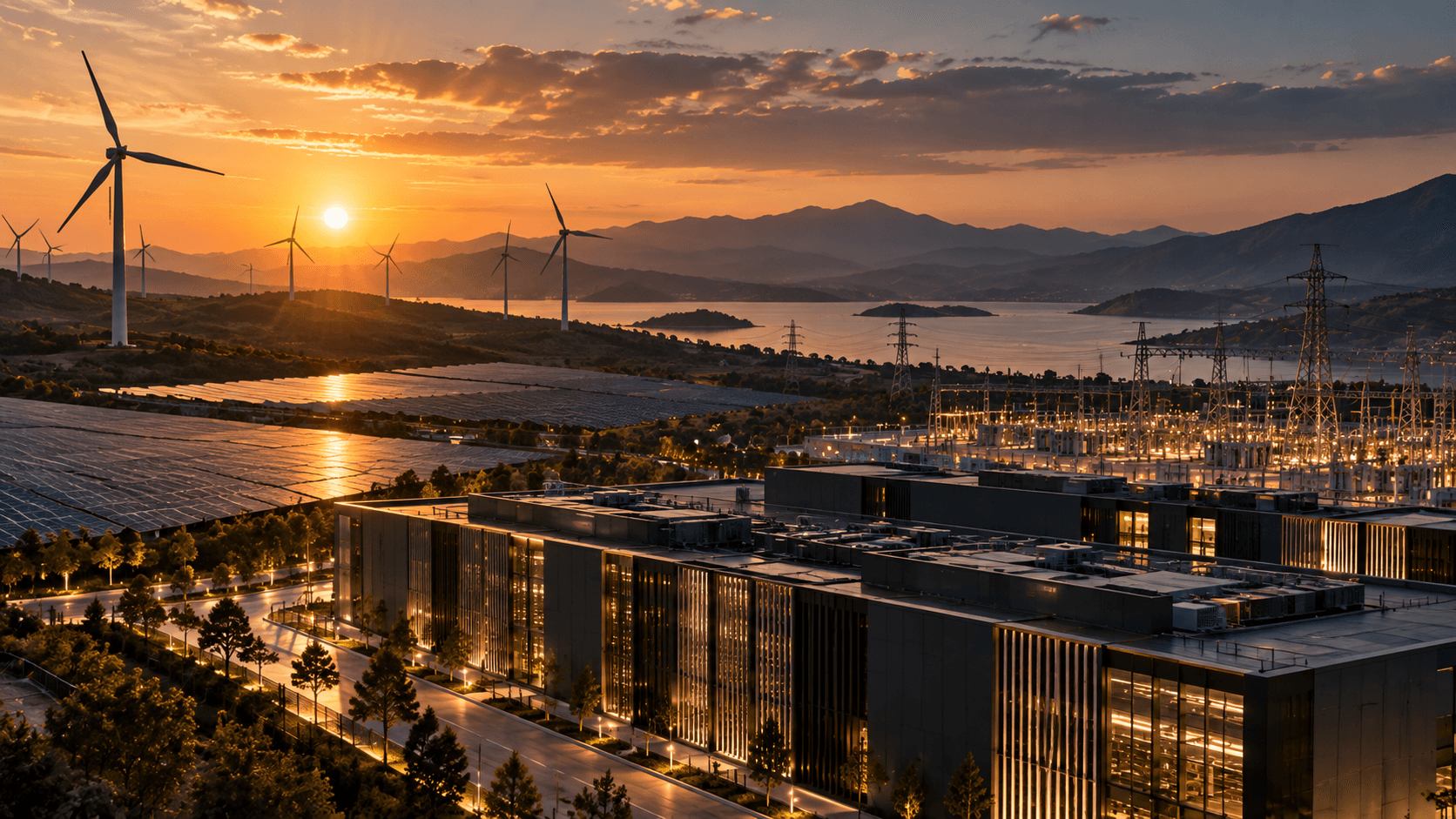
The International Energy Agency estimated global data center electricity consumption at approximately 415 TWh in 2024.
Its 2025 Energy and AI report projected that consumption could reach approximately 945 TWh by 2030 under its base-case scenario.
These are global figures. The 2030 estimate is a projection, not an observed outcome.
What Must Be Checked Before Selecting a Site?
- Available grid capacity: Can the local electricity network support the planned facility?
- Connection timetable: When can the required capacity actually be delivered?
- Electricity cost: How sensitive is the business model to changes in energy prices?
- Supply reliability: What backup systems and redundancy are required?
- Cooling requirements: Which cooling technologies are technically and commercially appropriate?
- Expansion potential: Can the site support future capacity increases?
Importantly, proximity to electricity generation does not automatically guarantee available grid connection capacity.
The suitability of a site must be confirmed through project-specific technical and regulatory assessment.
Where Can Investors Find Opportunities Beyond AI Software?
AI-related investment opportunities extend across several business and infrastructure categories.
Data Center Infrastructure
Land, buildings, power systems, cooling infrastructure and specialised computing facilities.
Electricity Infrastructure
Grid upgrades, electrical equipment, energy storage and technologies supporting power reliability.
Industrial Supply Chains
Engineering, construction, specialised components, electrical systems and technical services.
Applied AI Businesses
Companies using artificial intelligence to improve industrial operations, logistics and productivity.
How Do These Investment Models Differ?
| Investment Type | Primary Value Driver | Principal Risk |
|---|---|---|
| Data center property | Contracted infrastructure demand and facility utilisation. | Power constraints, development costs and customer concentration. |
| Electricity infrastructure | Demand for reliable power delivery. | Regulation, permitting and project execution. |
| Industrial suppliers | Orders for equipment, engineering and services. | Competition, margins and customer demand. |
| Applied AI companies | Customer adoption and measurable business value. | Technology changes, competition and scalability. |
These categories should not be treated as interchangeable.
An investor acquiring an industrial facility faces different risks from an investor financing a software company or a specialised electricity asset.
Which European Markets Are Relevant for AI Infrastructure?
There is no single European location suitable for every AI infrastructure project.
Location decisions depend on the intended business model, electricity requirements, customer proximity, connectivity, construction costs and regulatory conditions.
Established European data center markets benefit from existing digital infrastructure and commercial ecosystems.
However, mature markets can also face constraints involving land availability, electricity connections and development costs.
Other European regions may offer alternative development conditions, but their suitability must be evaluated individually.
What Should Investors Compare Between Countries?
| Criterion | Key Question |
|---|---|
| Electricity | Is the required capacity available at a viable cost and within a realistic timeframe? |
| Connectivity | Does the location offer suitable fibre networks and access to customers? |
| Industrial property | Are suitable sites available with appropriate zoning, utilities and development rights? |
| Workforce | Can the project access qualified engineering, technical and operational staff? |
| Regulation | What permits, environmental requirements and data-related obligations apply? |
| Commercial demand | Are there identifiable customers or credible long-term contractual opportunities? |
The most attractive location is not necessarily the one with the lowest land price.
A more expensive location with available electricity, strong connectivity and contracted customer demand may offer a more viable development proposition.
Can Bulgaria Attract AI Infrastructure Investment?
Bulgaria can be considered for selected AI-related infrastructure, industrial and business development activities. However, suitability depends on the requirements of each project, especially electricity capacity, digital connectivity, technical expertise, customer demand and regulatory conditions.
As a European Union member state, Bulgaria operates within the broader European economic and regulatory environment.
Its industrial activity, engineering capabilities and geographic position may be relevant to certain international business strategies.
Nevertheless, these characteristics do not automatically establish the commercial viability of a large AI computing facility.
What Opportunities Could Be Relevant?
- Industrial facilities and supporting technical infrastructure.
- Electrical equipment, engineering and installation services.
- Digital infrastructure and specialised technical operations.
- AI adoption in manufacturing, logistics and business services.
- Cross-border cooperation between international technology companies and regional industrial partners.
What Are the Main Constraints?
Large computing projects may require electricity capacity and technical infrastructure that are not available at every industrial location.
Other relevant considerations include workforce availability, financing, customer demand and the operational requirements of the intended facility.
For locations such as Sofia and Plovdiv, investors should examine the actual characteristics of individual sites rather than relying on general regional assumptions.
How Do You Evaluate a Data Center Site in Bulgaria?
Start with two site-specific checks: how much electrical capacity the network operator can make available, and when it can energise the site. Then confirm fibre routes with telecom providers, check the cooling design and review the permitting path. Use the same opening load and expansion assumptions when comparing sites in Sofia, Plovdiv or elsewhere in Bulgaria.
| What to check | Evidence to request | What could delay the project |
|---|---|---|
| Electrical capacity | A written assessment from the relevant network operator covering available MW at the proposed connection point and any upgrades needed for later phases. | The opening load cannot be supplied without new equipment or upstream network works. |
| Connection schedule and cost | Indicative dates for design, approvals, network works and energisation, with the cost and responsibility for each stage. | The proposed energisation date depends on work with an unconfirmed schedule or budget. |
| Fibre connectivity | Provider quotes and route maps showing separate building entry points and physically diverse paths where redundancy is required. | Two suppliers use the same duct or the same upstream route, leaving a shared point of failure. |
| Cooling, water and permits | A preliminary cooling design, expected electricity and water use, and written confirmation of which permits and utility approvals the design requires. | The design relies on a water supply or approval that has yet to be confirmed. |
The European Commission reports that fibre to the premises reached 93.5% of Bulgarian households in 2025, compared with 74.1% across the EU. These national figures provide context. Route diversity and available capacity still need to be verified for each parcel.
Sources: European Commission, Digital Decade country profile for Bulgaria, IEA, Energy and AI, and EU data centre energy and sustainability reporting framework. Checklist added .
See how Focus Invest Group supports strategic project development in Bulgaria and other markets.
What Does Business AI Adoption Tell Us?
According to Eurostat, 20.0% of EU enterprises with at least 10 employees used AI technologies in 2025.
Bulgaria recorded 8.5% under the same statistical measure.
This indicates lower reported business adoption relative to the EU average.
It may suggest opportunities for productivity improvements and technology implementation, but does not independently prove strong commercial demand for AI infrastructure.
Investment distinction: A market with relatively low business AI adoption may offer opportunities for software implementation and industrial modernisation without necessarily being the best location for a large-scale AI data center.
How AI Investment Connects to Traditional Industry
The development of AI infrastructure can create demand beyond the technology sector.
Construction companies, engineering businesses, electrical equipment suppliers and industrial service providers may participate in the development and operation of computing facilities.

AI can also influence existing industrial businesses through applications involving predictive maintenance, quality control, logistics optimisation and production planning.
However, these applications should be evaluated through measurable operational outcomes.
A business adopting AI should assess implementation costs, integration requirements, staff capabilities and expected productivity improvements.
What Should Investors Check Before Financing an AI Infrastructure Project?
Before committing capital, investors should assess whether the proposed project has a credible commercial and operational foundation.
Customer Demand
Are there identifiable customers, commercial commitments or realistic demand assumptions?
Electricity Availability
Can the required electricity capacity be secured within the proposed development timetable?
Total Development Cost
Does the financial model include land, construction, electrical infrastructure, cooling, equipment and financing?
Permits and Regulation
Are planning permissions, environmental requirements and relevant regulatory obligations understood?
Technical Delivery
Does the development team have the capabilities and resources required to complete the project?
Revenue Model
How will the project generate revenue, and how dependent is it on individual customers?
Downside Scenarios
What happens if construction is delayed, electricity becomes more expensive or customer demand develops more slowly?
Long-Term Competitiveness
Can the infrastructure adapt to changing technical requirements and commercial conditions?
Why Strategic Partnerships Matter in AI Infrastructure
Large infrastructure and industrial development projects often require cooperation between multiple parties.
These may include international technology companies, local industrial businesses, engineering providers, infrastructure specialists and commercial partners.
The quality of these relationships can influence project planning, execution and long-term operations.
At Focus Invest Group, our broader strategic perspective emphasises international business connectivity, commercial cooperation and the disciplined evaluation of opportunities.
For AI-related industrial development, these principles are relevant when identifying credible counterparties, understanding local conditions and assessing project feasibility.
Learn more about our international business network and strategic relationships .
AI Investment in Europe 2026: Investor Questions Answered
1. Where is AI investment going in Europe in 2026?
Important areas include computing infrastructure, data centers, electricity systems, connectivity, industrial technology and commercial AI applications. The suitability of each category depends on its revenue model, capital requirements and risks.
2. How much money is the EU investing in artificial intelligence?
The European Commission's InvestAI initiative aims to mobilise €200 billion. This is an announced investment mobilisation target, not confirmation that the full amount has been deployed.
3. Are AI data centers profitable?
They can be commercially viable, but profitability depends on customer contracts, utilisation, electricity costs, construction expenditure, financing and operating efficiency. Demand growth alone does not guarantee profitability.
4. Can an ordinary industrial building become an AI data center?
Potentially, but conversion requires a detailed technical assessment. The building must support sufficient electrical capacity, cooling, connectivity, security and structural requirements. Conversion costs may make a new purpose-built facility more appropriate.
5. Why is electricity availability important for AI investment?
AI computing equipment requires substantial and reliable electricity supply. Insufficient grid capacity or long connection delays can affect project costs, delivery schedules and commercial feasibility.
6. Which European country is best for AI infrastructure investment?
There is no universally best location. Investors must compare electricity availability, connectivity, customer demand, workforce, regulation, land suitability and total development costs.
7. Is Bulgaria suitable for AI infrastructure projects?
Bulgaria may be suitable for selected projects, but suitability must be assessed at site level. Electricity capacity, connectivity, technical requirements and customer demand are essential factors.
8. What is the difference between investing in AI companies and AI infrastructure?
AI companies may generate revenue from software, products or services. AI infrastructure investments typically involve physical assets or technical systems that support computing and digital operations. Their costs, risks and revenue structures differ.
9. What are the biggest risks of AI investment in Europe?
Major risks include high capital expenditure, electricity constraints, construction delays, technological changes, customer concentration, regulatory requirements and unrealistic revenue or valuation assumptions.
10. How can investors identify credible AI infrastructure opportunities?
Investors should verify customer demand, infrastructure readiness, permits, financing, technical capabilities, commercial contracts and the resilience of projected cash flows under adverse scenarios.
The Investment Opportunity Is in the Infrastructure Behind AI
The expansion of artificial intelligence creates demand for computing capacity, electricity, industrial equipment and specialised services.
These requirements connect digital innovation with traditional infrastructure and industrial development.
However, successful investment depends on more than participating in a growing sector.
Investors must identify projects with credible demand, deliverable infrastructure, realistic financial assumptions and effective execution.
For Focus Invest Group, the broader strategic relevance lies in the relationship between international business cooperation, regional industrial capabilities and long-term commercial opportunities.
The most important question is not simply how much capital is being announced for AI, but which businesses and assets can translate technological development into sustainable economic value.
Institutional Sources
- European Commission — InvestAI: €200 Billion Investment Mobilisation Initiative.
- European Commission — AI Continent Action Plan.
- International Energy Agency — Energy and AI.
- Eurostat — AI Adoption Among EU Enterprises, 2025.
- European Investment Bank — Research and Publications.
This article is provided for general informational and analytical purposes. Investment targets and projections are distinguished from completed investments and observed outcomes. Illustrative images do not depict specific investment projects. The article does not constitute individualised investment, financial or legal advice.