
Strategic Capital Infrastructure: How to Evaluate Long-Term Investment Opportunities
A practical guide to understanding how transport, energy, industrial infrastructure and regional connectivity influence investment decisions, business expansion and long-term economic value.
What Is Strategic Capital Infrastructure?
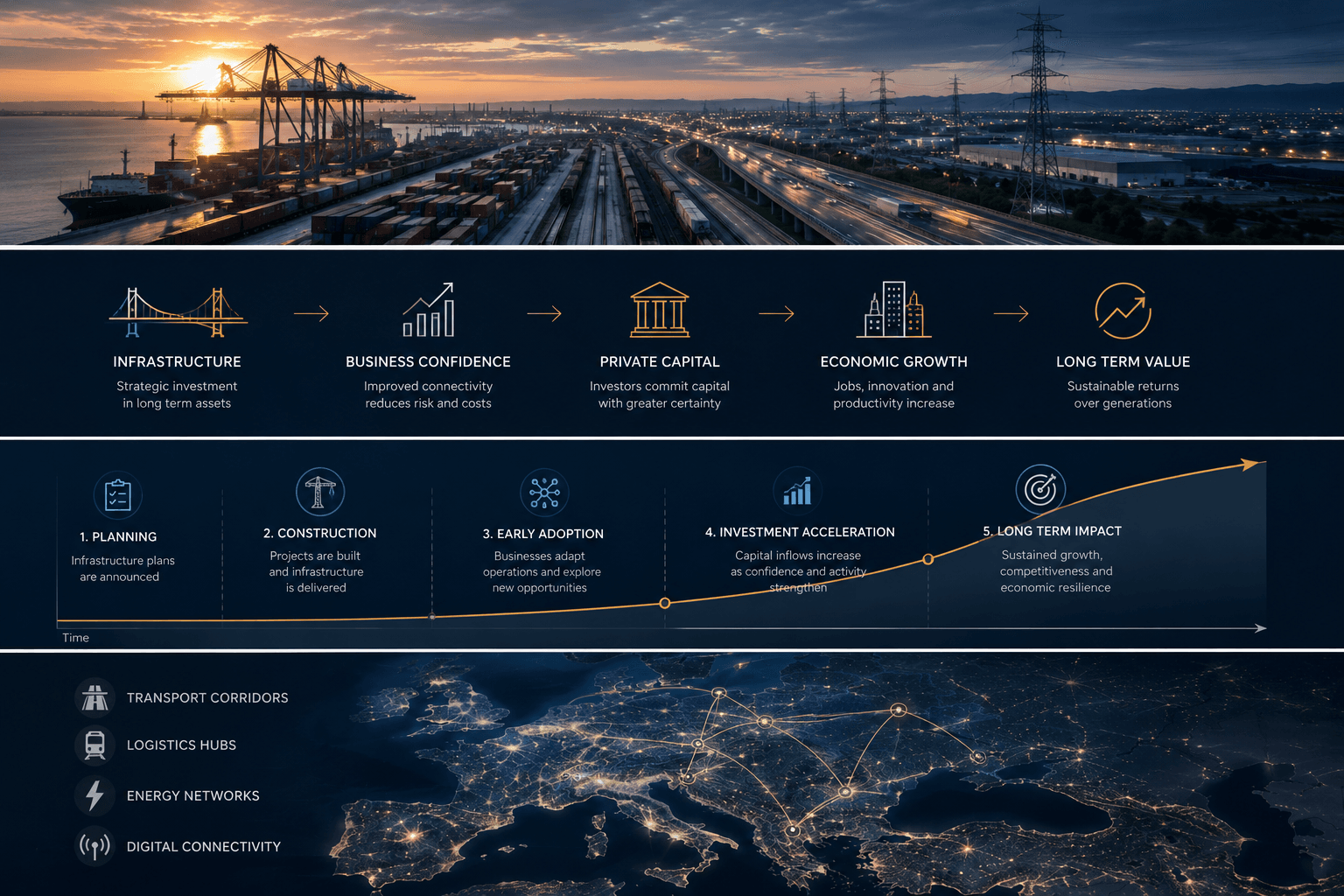
Strategic capital infrastructure is a useful analytical term for the relationship between long-term capital allocation and the physical systems that support economic activity. These systems include transport corridors, electricity networks, logistics facilities, industrial zones and digital connectivity.
The term is not a separate, universally defined investment asset class. In this article, it describes how investors and businesses evaluate infrastructure when making long-term commercial decisions.
In practical terms: infrastructure becomes strategically important when it improves access to markets, supports reliable operations, reduces material business constraints or enables productive economic activity.
Five Key Findings
- Infrastructure quality can influence where companies establish production, distribution and commercial operations.
- Reliable electricity, transport access and suitable industrial land are important feasibility considerations.
- Announced infrastructure projects should not be treated as completed or operational assets.
- Economic importance does not automatically mean an infrastructure project offers attractive financial returns.
- Investment evaluation requires evidence of demand, realistic costs, delivery capability and regulatory readiness.
Why Does Long-Term Capital Follow Infrastructure Development?
Infrastructure can change the economic conditions under which businesses operate.
For example, improved transport access may reduce delivery times, while reliable electricity supply can make an industrial site suitable for production that would otherwise be technically or commercially difficult.
These changes can influence business location decisions and the demand for surrounding facilities and services.
However, the relationship is not automatic. A new road, industrial park or energy project creates commercial value only when it addresses a genuine need and is supported by sufficient demand.
Investors therefore need to distinguish between infrastructure announcements, projects under construction and assets that are already operational.
Infrastructure Availability
Does the location already have the roads, electricity, utilities and connectivity needed for commercial operations?
Infrastructure Delivery
If essential systems are planned, are their financing, permits and construction timelines credible?
Which Infrastructure Indicators Should Investors Monitor?
The most useful indicators are those that directly affect project feasibility, operating costs and access to customers.
The following framework can be used as an initial screening tool when evaluating industrial locations, logistics facilities or regional expansion opportunities.
| Indicator | What to Verify | Why It Matters |
|---|---|---|
| Transport | Road access, freight routes, rail connections and actual travel times. | Delivery reliability, logistics costs and customer accessibility. |
| Electricity | Available capacity, connection conditions, reliability and timelines. | Operational feasibility and exposure to connection delays. |
| Industrial Land | Ownership, zoning, planning restrictions, permits and site conditions. | Development readiness and legal certainty. |
| Utilities | Water, wastewater, gas where relevant, and technical capacity. | Ability to support the intended operation. |
| Workforce | Skills availability, recruitment conditions and commuting access. | Operating continuity and labour costs. |
| Digital Connectivity | Fibre access, network reliability and redundancy. | Business continuity and digital operations. |
| Market Access | Distance to customers, suppliers and relevant trade corridors. | Supply-chain efficiency and commercial reach. |
This checklist is a starting point, not a substitute for technical, legal or financial due diligence.

How Can a Business Evaluate a Region Before Expanding?
A business considering a new industrial or commercial location should begin with its operational requirements, rather than with general claims about a region's growth potential.
For a manufacturing company, the most important factors may include electricity capacity, supplier proximity, transport reliability and workforce skills.
For a logistics operator, road connectivity, delivery times, warehouse availability and access to major customers may carry greater weight.
A practical regional assessment can follow five steps:
- Define operational requirements. Identify required site size, electricity demand, transport needs, workforce and delivery conditions.
- Verify existing infrastructure. Separate infrastructure already available from planned improvements.
- Compare realistic alternatives. Evaluate more than one location using consistent criteria.
- Estimate total operating costs. Include logistics, utilities, labour, site preparation and potential connection expenses.
- Assess implementation risk. Examine permitting, construction, supplier availability and possible delays.
This approach helps businesses avoid selecting locations based only on land prices, promotional claims or future infrastructure announcements.
Two Industrial Sites: Which One Is More Competitive?
Consider a hypothetical manufacturer comparing two locations.
Site A offers a lower purchase price but requires a significant electricity connection upgrade and additional road improvements.
Site B has a higher purchase price but already offers suitable electricity capacity, established road access and a more predictable development timeline.
Site A may initially appear cheaper. However, connection expenses, construction delays and lost operating time could increase its total economic cost.
Site B may offer a stronger commercial proposition if its existing infrastructure reduces implementation risk and supports earlier operations.
The correct decision depends on the complete project economics, not simply the land price.
This is an illustrative scenario, not an assessment of actual properties.
What Makes an Infrastructure Project Commercially Viable?
An infrastructure project can serve an important economic purpose without necessarily producing attractive financial returns for a particular investor.
Commercial viability depends on the relationship between project costs, expected utilisation, revenue arrangements, financing and operating risks.
1. Demonstrable Demand
Who will use the infrastructure, and what evidence supports the expected level of utilisation?
2. Credible Capital Budget
Does the financial plan include construction, equipment, land, financing, contingencies and long-term maintenance?
3. Revenue Sustainability
Are expected revenues supported by realistic pricing, customer commitments, regulated tariffs or other identifiable arrangements?
4. Delivery Capability
Can the project team obtain the necessary approvals, manage construction and deliver the asset within a credible timeframe?
5. Risk Allocation
Which parties bear construction, demand, operating, regulatory and financing risks?
The answers vary considerably between publicly financed infrastructure, private industrial facilities and public-private partnerships.
How Do Public and Private Capital Work Together?
Public investment often supports infrastructure with broad economic or social benefits, including transport systems, public utilities and essential connectivity.
Private capital may finance commercial facilities, industrial assets, logistics operations and other projects where an appropriate revenue model exists.
Public-private partnerships can combine resources and responsibilities, but their suitability depends on the project's legal framework, risk allocation and commercial structure.
A publicly important project is not automatically suitable for private financing.
Likewise, private participation does not eliminate construction, demand or regulatory risk.
For further institutional guidance, see the World Bank's Public-Private Partnership Reference resources .
What Role Does Infrastructure Play in Bulgaria's Industrial Competitiveness?
For companies evaluating Bulgaria as a manufacturing, logistics or commercial location, infrastructure quality should be assessed alongside labour, suppliers, regulation and access to European markets.
Industrial areas around Plovdiv and Sofia provide relevant examples of why regional evaluation must consider more than geographic location.
A company considering a site near Plovdiv, for example, should verify road access, electricity connection conditions, industrial zoning, labour availability and the location of suppliers and customers.
These factors are especially important for businesses considering nearshoring, supplier diversification or expansion into Southeast European markets.
The existence of an industrial cluster or transport corridor does not establish that every available site is equally suitable.
Project-level verification remains essential.
For information on European transport policy and networks, consult the European Commission's Trans-European Transport Network resources .
What Are the Main Risks of Infrastructure-Led Investment?
Infrastructure projects often involve long planning periods, substantial upfront expenditure and dependencies outside the investor's direct control.
- Construction risk: Cost overruns, contractor issues and project delays.
- Demand risk: Actual utilisation may be lower than projected.
- Regulatory risk: Permits, environmental requirements or applicable rules may change.
- Financing risk: Borrowing costs and funding availability can affect viability.
- Connection risk: Electricity or utility access may be delayed or insufficient.
- Market risk: Changes in industrial activity can affect demand for facilities and supporting services.
- Asset-specific risk: Technical requirements, maintenance costs and future competitiveness may differ between projects.
A disciplined investment assessment should test how the project performs under less favourable cost, demand and delivery scenarios.
Why Infrastructure Matters for International Business Cooperation
For Focus Invest Group, infrastructure is relevant to the wider commercial environment in which international business relationships and strategic partnerships develop.
Companies exploring new markets need to understand whether a region can support their operational requirements, supplier relationships and long-term objectives.
Infrastructure assessment can therefore contribute to more informed discussions about industrial cooperation, cross-border trade, business representation and commercial expansion.
This perspective does not imply that Focus Invest Group owns, finances or operates the infrastructure assets discussed in this article.
Explore our business scope and international network for more information.
Strategic Capital Infrastructure: Questions and Answers
What does strategic capital infrastructure mean?
Strategic capital infrastructure describes the relationship between long-term capital allocation and infrastructure that supports economic activity, including transport, electricity, logistics, industrial facilities and digital networks. It is an analytical concept, not a universally defined asset class.
Why is infrastructure important for long-term investment?
Infrastructure can influence business operating costs, market access, productivity and regional competitiveness. However, an infrastructure project must meet genuine demand and remain commercially viable to support sustainable investment value.
Which infrastructure indicators matter most to manufacturers?
Manufacturers commonly need to evaluate electricity capacity, transport access, suitable industrial land, utilities, workforce availability and proximity to suppliers and customers. The relative importance depends on the operation.
Does a new highway automatically increase nearby property values?
No. Improved accessibility can influence demand, but property values also depend on location, land-use restrictions, market conditions, existing supply and the actual economic benefits of the infrastructure.
How can investors identify infrastructure-related opportunities?
Investors can begin by examining documented demand, existing infrastructure constraints, credible development plans, commercial revenue models and project delivery risks. Independent technical, legal and financial assessment is essential.
What is the difference between infrastructure investment and industrial investment?
Infrastructure investment generally concerns systems and facilities that enable economic activity, such as transport and utility networks. Industrial investment concerns productive operations and assets, such as manufacturing facilities. The categories can overlap depending on the project.
Why does electricity capacity matter when choosing an industrial site?
Industrial operations require reliable electricity and, in some cases, substantial connection capacity. If adequate capacity is not available, connection upgrades, additional costs or delays may affect project feasibility.
Can infrastructure development attract foreign businesses?
Yes, suitable infrastructure can improve a region's attractiveness to foreign businesses by supporting operations and market access. Investment decisions also depend on labour, regulation, commercial demand, supplier networks and costs.
Is infrastructure investment always considered low risk?
No. Infrastructure projects can involve construction, financing, regulatory, operating and demand risks. Risk levels depend on the specific asset, financing structure, contractual arrangements and market conditions.
What should businesses verify before selecting a location in Bulgaria?
Businesses should verify land ownership and zoning, electricity and utility connection conditions, transport access, workforce availability, relevant permits and total implementation costs. Requirements vary by industry and location.
Infrastructure Creates Possibilities. Commercial Fundamentals Determine Value.
Strategic capital infrastructure provides a useful framework for understanding how physical systems influence business development and investment decisions.
Transport networks, electricity capacity, industrial land and digital connectivity can help create the conditions for economic activity.
Yet infrastructure alone does not guarantee commercial success.
Long-term investment decisions require evidence of demand, realistic project economics, regulatory readiness and execution capability.
For internationally active businesses, the practical objective is to identify locations and partnerships where infrastructure capabilities match genuine operational needs.
At Focus Invest Group , this perspective informs our interest in international business relationships, strategic cooperation and commercially grounded development opportunities.
Institutional Sources & Further Reading
- World Bank — Infrastructure. Research and resources concerning
infrastructure and economic development.
World Bank Infrastructure - World Bank — Public-Private Partnerships. Guidance on infrastructure
project structures and risk allocation.
PPP Reference Resources - European Investment Bank. European infrastructure financing,
investment priorities and publications.
EIB Publications - European Commission — TEN-T. European transport infrastructure
policy and network development.
Trans-European Transport Network - OECD — Infrastructure. Policy analysis concerning
infrastructure investment
and governance.
OECD
Editorial note: This article provides a general analytical framework. The industrial site comparison is hypothetical. It does not evaluate a specific investment project or constitute investment, financial or legal advice.